
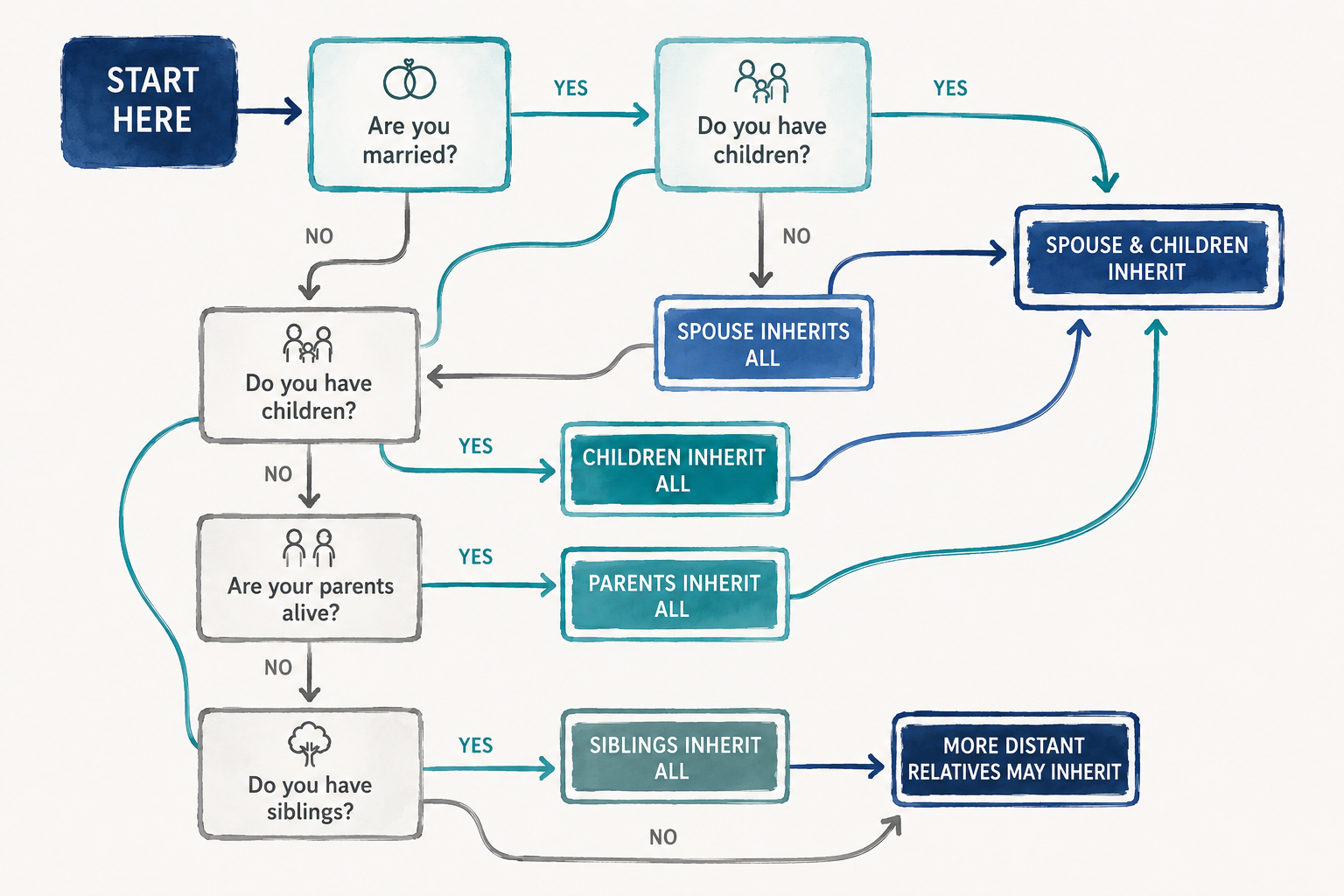
If you don’t have an estate plan, the State of California generously provides one for you. It’s called intestate succession.
Intestate succession is California’s default estate plan when someone dies without a will or other estate plan. It works by applying a series of “if this, then that” rules based on your family situation when you die. Are you married? Do you have children? Is your property community property or separate property? Once those questions are answered, California’s Probate Code determines who inherits your estate.
The important point isn’t memorizing the rules. It’s understanding that the government has already written them. If you don’t create your own estate plan, those default rules become your plan. In many cases, your loved ones will also have to go through the California probate process to carry out those rules.
One Size Doesn’t Fit Every Family
Even when California’s default plan distributes property exactly as the law intends, it can’t make personal decisions for your family.
One situation I frequently see involves blended families. You’ve remarried and have children from a prior relationship. Your goal is simple: you want your current spouse to be able to continue living in the family home for the rest of their life, but after your spouse passes away, you want your share of the home to go to your children.
You might assume that’s what California’s default estate plan would accomplish. It doesn’t. If the home is community property, your surviving spouse inherits your interest outright. Your children don’t inherit your share of the home, and your spouse is free to decide what happens to it next.
The law can’t read your mind.
California’s default rules don’t know that you wanted to provide for your spouse during their lifetime while preserving an inheritance for your children. They simply apply the law.
Blended families are just one example. Perhaps one child is financially responsible while another struggles with addiction. Maybe you have a beneficiary with special needs. Those aren’t decisions the government can make for you. They’re deeply personal choices that depend on your family, your values, and your goals. An estate plan gives you the opportunity to make those decisions yourself instead of relying on California’s default rules.
Your Family Deserves Better Than the Default
After years of helping families create estate plans, I’ve learned that most people aren’t worried about the law. They’re worried about making sure the people they love are taken care of.
Fortunately, California’s plan is only the default. It only applies if you don’t create one of your own.
A thoughtfully designed estate plan allows you to decide who inherits your property, who will make decisions on behalf of your family, and how your beneficiaries receive their inheritance. Rather than relying on California’s one-size-fits-all rules, you can create a plan that reflects your values, your priorities, and the people you love.
As an added benefit, a properly designed estate plan can often allow your loved ones to avoid the probate process altogether.
If you don’t already have an estate plan, or if it’s been years since you reviewed it, now is a good time to make sure it still reflects your wishes and your family’s needs. If you’re not sure whether it’s still up to date, consider whether your estate plan may be referring to someone who no longer exists.Estate planning isn’t about predicting the future. It’s about making sure the decisions that matter most are yours to make.
If you’re ready to replace California’s default plan with one that’s designed for your family, we’d be happy to help. Contact Blue Water Estate Planning to schedule a consultation.
The question isn’t whether a plan exists. The question is whether it will be your plan or California’s.